
When research protocols intersect with surgical preparation timelines, understanding the pharmacokinetic properties of investigational compounds becomes paramount. Retatrutide before surgery presents unique considerations for researchers examining pre-operative peptide clearance, metabolic effects, and protocol timing—particularly given its triple-agonist mechanism and extended half-life profile. As laboratories worldwide investigate this novel GLP-1/GIP/glucagon receptor agonist, questions surrounding appropriate discontinuation windows, metabolic persistence, and surgical safety parameters demand rigorous scientific attention.
The intersection of peptide research and surgical protocols represents a critical knowledge gap in contemporary biomedical investigation. With retatrutide demonstrating significant metabolic effects and prolonged systemic presence, research teams must carefully consider timing, clearance rates, and physiological impact when designing studies that involve surgical interventions or procedures requiring metabolic stability.
Key Takeaways
- Retatrutide’s extended half-life (approximately 6-7 days) requires significantly longer pre-surgical discontinuation periods compared to shorter-acting peptides
- Triple receptor agonism (GLP-1, GIP, glucagon) creates complex metabolic effects that persist beyond standard clearance calculations
- Research protocols must account for at least 4-5 half-lives (28-35 days) to ensure adequate compound clearance before surgical procedures
- Metabolic monitoring throughout the pre-operative period provides essential data on glucose regulation, fluid balance, and tissue recovery capacity
- Quality documentation from suppliers like PEPTIDE PRO ensures researchers work with verified, research-grade compounds for accurate protocol development
Understanding Retatrutide: Pharmacological Profile and Surgical Considerations
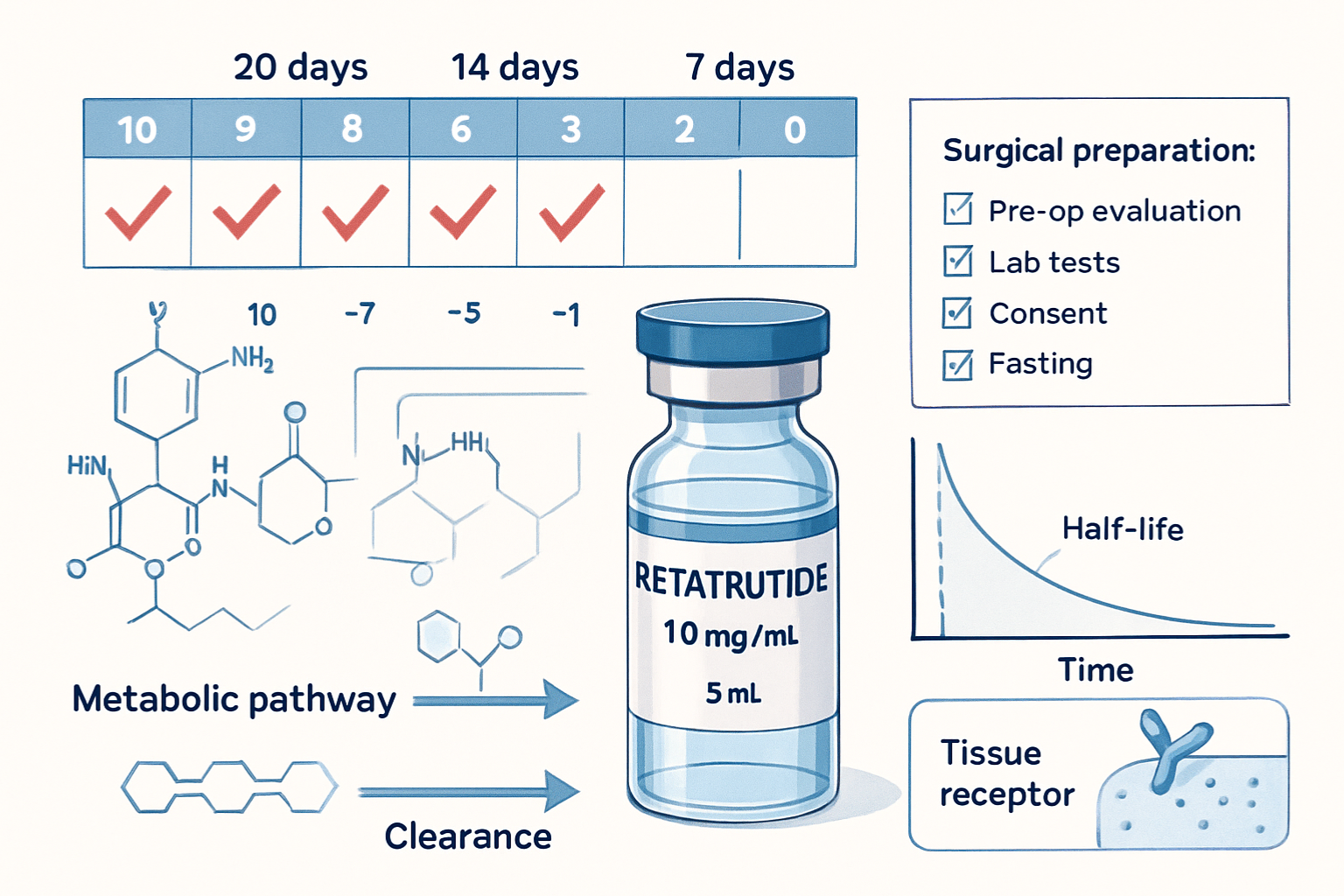
The Triple-Agonist Mechanism
Retatrutide represents a significant advancement in peptide research as a triple receptor agonist targeting GLP-1 (glucagon-like peptide-1), GIP (glucose-dependent insulinotropic polypeptide), and glucagon receptors simultaneously. This unique pharmacological profile creates metabolic effects that extend far beyond traditional single-pathway peptides.
The compound’s mechanism involves:
- GLP-1 receptor activation: Influences insulin secretion, gastric emptying, and appetite regulation
- GIP receptor engagement: Modulates insulin response and lipid metabolism
- Glucagon receptor stimulation: Affects energy expenditure and hepatic glucose production
This triple action creates a complex metabolic landscape that researchers must thoroughly understand when planning surgical research protocols.
Pharmacokinetic Properties Critical for Pre-Surgical Planning
| Pharmacokinetic Parameter | Retatrutide Value | Research Implication |
|---|---|---|
| Half-life | ~6-7 days | Extended clearance period required |
| Time to peak concentration | 24-48 hours | Delayed onset considerations |
| Steady-state achievement | 4-5 weeks | Long-term metabolic effects |
| Elimination route | Proteolytic degradation | Tissue distribution factors |
| Protein binding | High | Prolonged systemic presence |
These pharmacokinetic characteristics make retatrutide before surgery a particularly important consideration for research teams. The extended half-life means that metabolic effects persist substantially longer than many commonly studied peptides, requiring adjusted pre-operative protocols.
Metabolic Effects Relevant to Surgical Research
Research investigating retatrutide has documented several metabolic changes that directly impact surgical preparation protocols:
Glucose Regulation 🔬
The compound’s effect on insulin secretion and glucose homeostasis creates considerations for pre-operative fasting protocols and perioperative glucose management in research models.
Gastric Emptying Modifications
Delayed gastric emptying—a characteristic effect of GLP-1 agonism—presents specific concerns for aspiration risk assessment and anesthesia protocols in experimental settings.
Fluid and Electrolyte Balance
The glucagon receptor component influences renal function and fluid distribution, requiring careful monitoring during pre-surgical preparation phases.
Cardiovascular Parameters
Research has documented effects on heart rate, blood pressure, and cardiac output that may influence hemodynamic stability during surgical procedures.
Pre-Surgical Discontinuation Protocols for Retatrutide Research
Calculating Appropriate Clearance Windows
When designing research protocols involving retatrutide before surgery, calculating adequate clearance time requires understanding the principle of half-life elimination. The standard pharmacological guideline suggests that approximately 97% of a compound is eliminated after 5 half-lives.
For retatrutide with a 6-7 day half-life:
- 1 half-life: 6-7 days (50% elimination)
- 2 half-lives: 12-14 days (75% elimination)
- 3 half-lives: 18-21 days (87.5% elimination)
- 4 half-lives: 24-28 days (93.75% elimination)
- 5 half-lives: 30-35 days (96.875% elimination)
Research Protocol Recommendation: Most surgical research protocols should implement a minimum discontinuation period of 4-5 half-lives (28-35 days) before scheduled procedures to ensure adequate metabolic normalization.
Factors Influencing Individual Clearance Rates
Research teams must recognize that standard half-life calculations represent population averages. Several factors can influence individual clearance rates in experimental models:
Metabolic Rate Variations ⚡
Baseline metabolic function significantly affects peptide processing and elimination kinetics.
Tissue Distribution
Retatrutide’s high protein binding creates tissue reservoirs that may release compound gradually, extending effective clearance time beyond theoretical calculations.
Dosing History
Cumulative dosing and steady-state achievement mean that subjects on long-term protocols require longer clearance periods than those receiving single or short-term administration.
Renal and Hepatic Function
Organ function status directly impacts elimination pathways and clearance efficiency.
Comparative Clearance: Retatrutide vs. Other Research Peptides
Understanding how retatrutide compares to other commonly researched peptides helps contextualize pre-surgical planning:
| Peptide Compound | Approximate Half-Life | Recommended Pre-Surgical Discontinuation |
|---|---|---|
| Retatrutide | 6-7 days | 28-35 days |
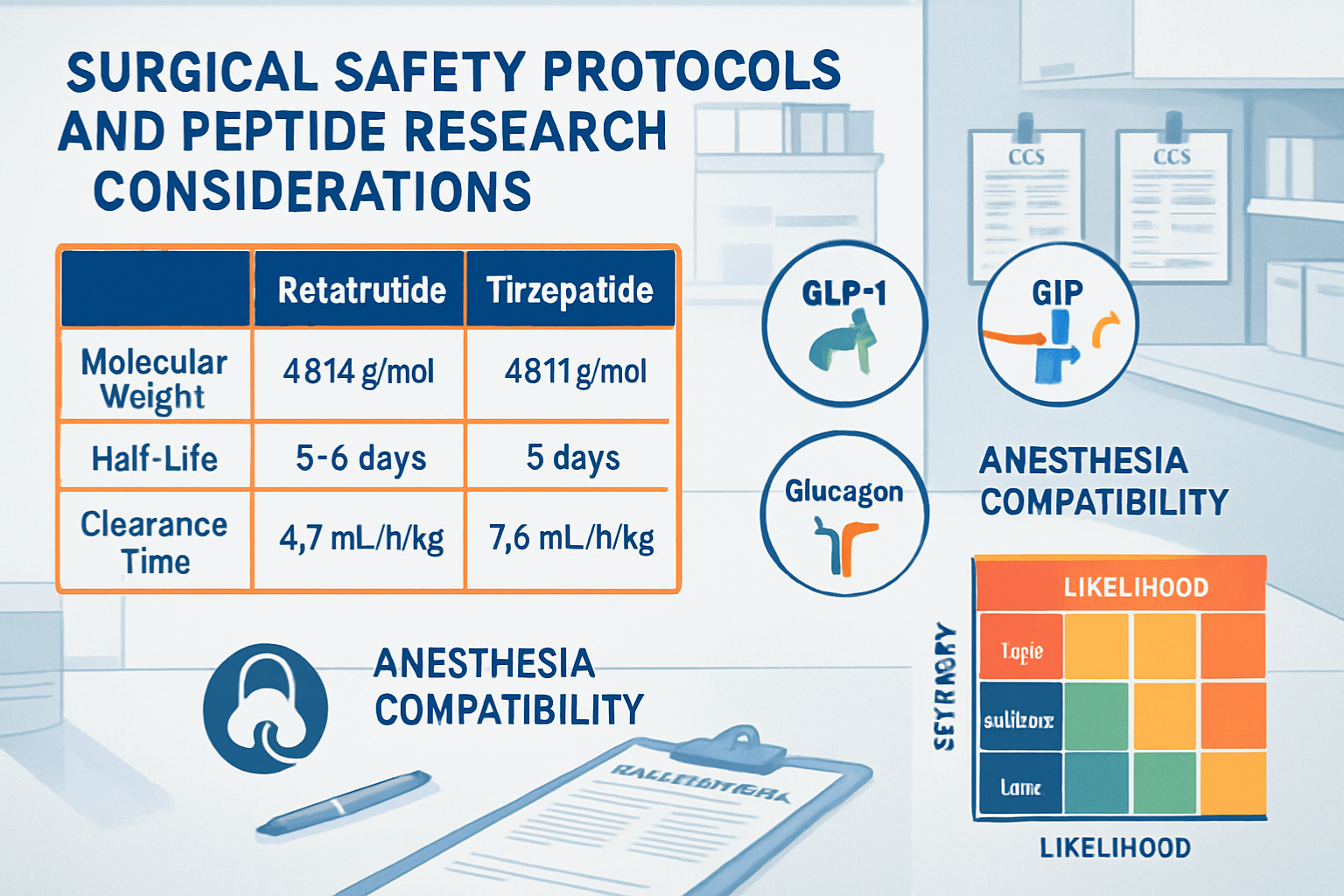
| Tirzepatide | ~5 days | 20-25 days |
| Semaglutide | ~7 days | 28-35 days |
| Liraglutide | ~13 hours | 3-5 days |
| BPC-157 | ~4 hours | 1-2 days |
| TB-500 | ~10 hours | 2-3 days |
This comparison demonstrates why retatrutide requires substantially longer pre-operative planning compared to shorter-acting research compounds. Teams working with research-grade peptides must adjust protocols accordingly based on specific compound pharmacokinetics.
Monitoring Metabolic Normalization
Simply calculating half-lives provides theoretical guidance, but research protocols benefit from active monitoring of metabolic parameters to confirm functional normalization before surgical procedures:
Glucose Homeostasis Assessment 📊
- Fasting glucose levels
- Postprandial glucose response
- Insulin sensitivity markers
- HbA1c trends (for longer-term studies)
Gastrointestinal Function Markers
- Gastric emptying rate assessment
- Appetite and satiety normalization
- Digestive enzyme activity
Cardiovascular Stability Indicators
- Resting heart rate patterns
- Blood pressure stability
- Cardiac output measurements
Body Composition Changes
- Weight stabilization
- Fluid balance normalization
- Electrolyte panel consistency
These monitoring protocols provide empirical evidence of metabolic return to baseline, supplementing theoretical clearance calculations.
Surgical Safety Considerations in Retatrutide Research Protocols
Anesthesia Interactions and Metabolic Effects
Research examining retatrutide before surgery must carefully consider potential interactions between residual peptide effects and anesthetic agents. While retatrutide itself is not directly contraindicated with standard anesthetic protocols, its metabolic effects create several considerations:
Delayed Gastric Emptying and Aspiration Risk ⚠️
The GLP-1 component of retatrutide’s mechanism significantly slows gastric emptying. Even after discontinuation, residual effects may persist, creating elevated aspiration risk during anesthesia induction. Research protocols should incorporate:
- Extended fasting periods beyond standard pre-operative guidelines
- Gastric emptying confirmation when feasible
- Rapid sequence induction considerations
- Airway protection strategies
Glucose Management During Procedures
Retatrutide’s complex effects on glucose regulation—combining insulin secretion enhancement with glucagon receptor activation—create unique glycemic considerations during surgical stress responses. Research teams must establish:
- Baseline glucose stability before procedures
- Intraoperative glucose monitoring protocols
- Intervention thresholds for hypo/hyperglycemia
- Post-operative glucose management strategies
Hemodynamic Stability Factors
Research has documented cardiovascular effects including heart rate modulation and blood pressure changes with GLP-1/GIP agonists. Pre-surgical assessment should include:
- Cardiovascular parameter stabilization confirmation
- Baseline hemodynamic profiling
- Fluid status optimization
- Electrolyte balance verification
Wound Healing and Tissue Recovery Considerations
An emerging area of research interest involves how metabolic peptides like retatrutide might influence post-surgical healing processes. While comprehensive data remains limited, several theoretical considerations warrant attention:
Metabolic State and Healing Capacity 🔬
The compound’s effects on energy metabolism, protein synthesis, and cellular function may influence tissue repair mechanisms. Research protocols should consider:
- Baseline metabolic function assessment
- Nutritional status optimization
- Protein synthesis capacity evaluation
- Inflammatory response profiling
Tissue Perfusion and Vascular Function
Cardiovascular and metabolic effects may influence microvascular perfusion critical for wound healing. Monitoring should include:
- Tissue oxygenation parameters
- Capillary refill and perfusion markers
- Inflammatory mediator levels
- Healing progression benchmarks
Risk Stratification for Research Protocols
Not all surgical research protocols carry equal risk when retatrutide exposure is part of the experimental timeline. Teams should implement risk stratification to determine appropriate clearance windows:
Low-Risk Procedures (Minor, superficial, minimal metabolic stress)
- May proceed with standard 4-5 half-life clearance
- Basic metabolic monitoring sufficient
- Standard pre-operative protocols
Moderate-Risk Procedures (Significant tissue manipulation, moderate metabolic demand)
- Consider extended clearance periods (6+ half-lives)
- Enhanced metabolic monitoring
- Specialized pre-operative optimization
High-Risk Procedures (Major surgery, significant metabolic stress, critical organ involvement)
- Extended clearance periods (6-8 half-lives minimum)
- Comprehensive metabolic profiling
- Multi-parameter monitoring
- Specialized anesthesia protocols
This stratification approach allows research teams to balance scientific objectives with safety considerations when designing protocols involving retatrutide before surgery.
Laboratory Protocol Development: Integrating Retatrutide and Surgical Research
Designing Comprehensive Research Timelines
Creating robust research protocols that incorporate both retatrutide administration and surgical procedures requires meticulous timeline planning. Researchers must account for multiple phases:
Phase 1: Baseline Establishment (Weeks 1-2)
Before any peptide administration, establish comprehensive baseline parameters:
- Complete metabolic panel
- Cardiovascular function assessment
- Body composition analysis
- Behavioral and functional baselines
Phase 2: Peptide Administration Period (Variable duration)
The active research intervention phase with retatrutide administration:
- Systematic dosing protocols
- Regular monitoring intervals
- Effect documentation
- Adverse event tracking
Phase 3: Discontinuation and Clearance (Weeks 4-5 minimum)
The critical pre-surgical preparation period:
- Cessation of retatrutide administration
- Active metabolic monitoring
- Normalization confirmation
- Pre-operative optimization
Phase 4: Surgical Procedure and Recovery
The intervention phase with appropriate safety protocols:
- Pre-operative assessment confirmation
- Procedure execution
- Post-operative monitoring
- Recovery documentation
Phase 5: Post-Surgical Analysis
Long-term outcome assessment:
- Healing progression
- Metabolic parameter tracking
- Comparative analysis
- Data synthesis
Documentation and Quality Control Standards
Research involving retatrutide before surgery demands exceptional documentation standards to ensure reproducibility and scientific validity. Essential documentation elements include:
Compound Verification and Handling 📋
- Certificate of Analysis (COA) from reputable suppliers
- Purity verification (>98% for research-grade compounds)
- Storage condition documentation
- Reconstitution protocols
- Stability testing data
Working with established suppliers like PEPTIDE PRO ensures access to properly documented, research-grade compounds with appropriate quality certifications.
Protocol Adherence Records
- Detailed administration logs
- Timing documentation
- Dose calculations and verification
- Discontinuation date recording
- Clearance period tracking
Monitoring Data Collection
- Systematic parameter measurement
- Standardized assessment intervals
- Multi-parameter integration
- Trend analysis documentation
Adverse Event Reporting
- Comprehensive event documentation
- Severity classification
- Intervention recording
- Outcome tracking
Ethical Considerations and Institutional Review
Research protocols combining peptide administration with surgical procedures require rigorous ethical oversight. Institutional review boards and ethics committees will scrutinize several aspects:
Scientific Justification 🔍
- Clear research objectives
- Literature-supported rationale
- Risk-benefit analysis
- Alternative approach consideration
Safety Protocol Adequacy
- Appropriate clearance periods
- Comprehensive monitoring plans
- Emergency intervention protocols
- Veterinary oversight (for animal research)
Minimization of Harm
- Justified intervention necessity
- Appropriate analgesia protocols
- Humane endpoints
- Refinement of procedures
Data Management and Transparency
- Pre-registration of protocols
- Data sharing commitments
- Publication plans
- Conflict of interest disclosure
Collaborative Approaches: Integrating Expertise
Optimal research protocols involving retatrutide before surgery benefit from multidisciplinary collaboration:
Pharmacology Expertise
Understanding peptide mechanisms, pharmacokinetics, and metabolic effects requires specialized knowledge of peptide pharmacology and receptor biology.
Surgical Technique Specialists
Surgical procedure design, execution, and outcome assessment demand expertise in relevant surgical disciplines and techniques.
Anesthesiology Consultation
Safe anesthetic protocols accounting for peptide effects require anesthesiology input, particularly for complex or high-risk procedures.
Metabolic Monitoring Specialists
Comprehensive assessment of glucose regulation, energy metabolism, and endocrine function benefits from endocrinology or metabolism expertise.
Biostatistics and Data Analysis
Rigorous experimental design, power calculations, and statistical analysis require biostatistical collaboration to ensure valid conclusions.
This integrated approach ensures that all aspects of the research protocol—from peptide administration through surgical intervention to outcome analysis—meet the highest scientific standards.
Practical Guidelines for Research Teams: Retatrutide Pre-Surgical Protocols
Standard Operating Procedure Template
Research teams can adapt the following framework when developing protocols involving retatrutide before surgery:
Step 1: Protocol Design and Approval ✅
- Define research objectives and hypotheses
- Establish experimental groups and controls
- Calculate sample sizes with statistical power
- Design comprehensive timeline
- Obtain institutional ethics approval
- Secure necessary permits and authorizations
Step 2: Compound Procurement and Verification
- Source research-grade retatrutide from verified suppliers
- Verify Certificate of Analysis and purity documentation
- Implement proper storage conditions (-20°C to -80°C for lyophilized peptides)
- Establish reconstitution protocols
- Document batch numbers and expiration dates
Researchers requiring high-purity compounds can explore options through specialized peptide suppliers offering comprehensive quality documentation.
Step 3: Baseline Assessment
- Complete physical examination
- Comprehensive metabolic panel
- Cardiovascular function tests
- Body composition analysis
- Behavioral assessment (if applicable)
- Photographic documentation
Step 4: Retatrutide Administration Phase
- Implement dosing schedule per protocol
- Systematic monitoring at defined intervals
- Document all observations and measurements
- Track any adverse events
- Maintain detailed administration logs
Step 5: Discontinuation and Clearance Period
- Minimum 28-35 days before scheduled surgery
- Weekly metabolic monitoring
- Gastric emptying assessment (if feasible)
- Cardiovascular stability confirmation
- Weight and body composition tracking
- Glucose homeostasis verification
Step 6: Pre-Operative Assessment
- Comprehensive metabolic panel confirmation
- Cardiovascular clearance
- Fasting protocol implementation
- Anesthesia risk assessment
- Surgical site preparation
- Final safety verification
Step 7: Surgical Procedure
- Anesthesia induction with aspiration precautions
- Intraoperative monitoring (glucose, hemodynamics, vital signs)
- Procedure execution per protocol
- Recovery monitoring
- Post-operative analgesia
Step 8: Post-Operative Monitoring and Analysis
- Systematic recovery assessment
- Wound healing documentation
- Metabolic parameter tracking
- Complication surveillance
- Long-term outcome measurement
- Data analysis and interpretation
Troubleshooting Common Protocol Challenges
Research teams implementing retatrutide pre-surgical protocols may encounter several challenges:
Challenge: Incomplete Metabolic Normalization 🔧
Observation: Metabolic parameters remain altered beyond expected clearance period
Solutions:
- Extend clearance period by additional 1-2 half-lives
- Implement supportive metabolic interventions
- Consider individual variation in clearance rates
- Reassess surgical timing feasibility
- Document extended clearance for protocol refinement
Challenge: Scheduling Conflicts
Observation: Extended clearance requirements create timeline constraints
Solutions:
- Build flexible timelines into initial protocol design
- Establish rolling enrollment to maintain project momentum
- Consider alternative peptide compounds with shorter half-lives for preliminary studies
- Implement parallel cohorts at different protocol stages
Challenge: Variable Individual Responses
Observation: Significant inter-subject variability in clearance and normalization
Solutions:
- Implement individualized monitoring protocols
- Establish objective normalization criteria rather than fixed timelines
- Increase sample sizes to account for variability
- Stratify analysis by clearance patterns
- Consider pharmacogenetic factors if applicable
Challenge: Limited Baseline Data on Retatrutide-Surgery Interactions
Observation: Insufficient published literature for specific protocol questions
Solutions:
- Extrapolate from related GLP-1/GIP agonist data
- Implement conservative safety margins
- Conduct preliminary pilot studies
- Engage expert consultation
- Contribute findings to scientific literature
Quality Assurance and Validation
Ensuring protocol integrity requires systematic quality assurance measures:
Compound Quality Verification ✓
- Third-party purity testing when feasible
- Stability confirmation throughout storage period
- Reconstitution validation
- Concentration verification
- Contamination screening
Equipment Calibration
- Regular calibration of measurement devices
- Temperature monitoring for storage units
- Analytical equipment validation
- Documentation of maintenance schedules
Personnel Training
- Standardized training protocols
- Competency verification
- Inter-rater reliability assessment
- Ongoing education and updates
Data Integrity
- Real-time data entry systems
- Duplicate data verification
- Audit trails for all modifications
- Secure data storage and backup
- Blinding protocols where applicable
Emerging Research Questions and Future Directions
Unanswered Questions in Retatrutide Pre-Surgical Research
The intersection of retatrutide research and surgical protocols remains an evolving field with numerous unanswered questions:
Optimal Clearance Timing for Specific Procedures 🔬
While general guidelines suggest 4-5 half-lives, specific surgical types may require different approaches. Research questions include:
- Do minimally invasive procedures require shorter clearance periods?
- How do emergency surgical situations affect risk-benefit calculations?
- What clearance periods optimize outcomes for specific organ systems?
Long-Term Metabolic Effects Post-Discontinuation
Understanding whether retatrutide creates lasting metabolic changes that persist beyond compound clearance:
- Are there epigenetic modifications affecting long-term metabolism?
- Do tissue-level changes persist after systemic clearance?
- How do duration and dose of exposure affect residual effects?
Interaction with Specific Anesthetic Agents
Comprehensive understanding of retatrutide interactions with various anesthetic protocols:
- Do specific induction agents carry differential risk?
- How do regional vs. general anesthesia approaches compare?
- What monitoring parameters best predict anesthetic complications?
Impact on Wound Healing and Tissue Repair
The relationship between retatrutide exposure and post-surgical recovery:
- Does prior retatrutide exposure enhance or impair healing?
- Are there tissue-specific effects on repair mechanisms?
- How does timing of discontinuation affect healing outcomes?
Comparative Research Opportunities
Retatrutide vs. Other Multi-Receptor Agonists
Comparing pre-surgical considerations across different peptide classes:
- How do dual agonists (tirzepatide) compare to triple agonists (retatrutide)?
- What are the relative safety profiles for surgical research?
- Do different receptor combinations create distinct pre-operative considerations?
Researchers exploring these questions can access various peptide compounds through suppliers offering comprehensive research peptide portfolios.
Dose-Dependent Effects on Surgical Outcomes
Investigating whether retatrutide dosing affects pre-surgical planning:
- Do higher doses require extended clearance periods?
- Is there a dose threshold below which surgical timing is less critical?
- How does cumulative exposure affect recommendations?
Combination Protocols
Understanding retatrutide in combination with other research compounds:
- How do combination protocols affect clearance calculations?
- Are there synergistic effects requiring special consideration?
- What monitoring approaches best capture multi-compound effects?
Technological Advances Supporting Protocol Optimization
Real-Time Metabolic Monitoring 📊
Emerging technologies enabling continuous assessment:
- Continuous glucose monitoring systems
- Wearable metabolic sensors
- Real-time cardiovascular telemetry
- Advanced imaging for gastric emptying
Pharmacokinetic Modeling Tools
Computational approaches for individualized predictions:
- Population pharmacokinetic models
- Individual clearance prediction algorithms
- Bayesian adaptive dosing platforms
- Machine learning integration for personalized timelines
Biomarker Development
Identifying specific markers for retatrutide effects:
- Receptor occupancy assays
- Metabolite profiling
- Tissue-specific effect markers
- Clearance confirmation biomarkers
Translational Implications
While PEPTIDE PRO supplies compounds strictly for research use, understanding pre-surgical protocols in experimental settings may eventually inform clinical considerations:
Protocol Refinement for Human Studies
Research findings contribute to understanding:
- Optimal timing recommendations
- Safety monitoring parameters
- Risk stratification approaches
- Individual variation factors
Regulatory Guidance Development
Experimental data supports development of:
- Evidence-based guidelines
- Standardized protocols
- Safety recommendations
- Quality standards
Clinical Decision Support
Research insights may eventually inform:
- Pre-operative assessment tools
- Risk calculators
- Monitoring protocols
- Patient education materials
Integrating Scientific Rigor with Practical Implementation
Research involving retatrutide before surgery demands exceptional attention to pharmacokinetic principles, metabolic monitoring, and safety protocols. The compound’s unique triple-agonist mechanism and extended half-life create specific considerations that distinguish it from shorter-acting research peptides.
Key Implementation Principles
Prioritize Adequate Clearance Time ⏰
The single most critical factor in pre-surgical retatrutide protocols is allowing sufficient time for metabolic normalization. A minimum clearance period of 28-35 days (4-5 half-lives) provides the foundation for safe surgical research protocols, with extensions warranted for high-risk procedures or individual variation.
Implement Comprehensive Monitoring
Theoretical clearance calculations must be supplemented with empirical assessment of metabolic normalization. Multi-parameter monitoring—including glucose homeostasis, cardiovascular stability, gastrointestinal function, and body composition—provides objective evidence of readiness for surgical procedures.
Maintain Rigorous Documentation
From compound procurement through post-surgical analysis, comprehensive documentation ensures reproducibility, enables troubleshooting, and contributes to the broader scientific understanding of retatrutide in surgical contexts. Working with suppliers who provide thorough quality documentation, such as PEPTIDE PRO’s research-grade compounds, supports this documentation standard.
Embrace Multidisciplinary Collaboration
Optimal protocols integrate expertise across pharmacology, surgery, anesthesiology, metabolism, and biostatistics. This collaborative approach addresses the complex intersection of peptide research and surgical science.
Contribute to Scientific Knowledge
As an emerging area of investigation, every well-designed protocol involving retatrutide and surgical procedures contributes valuable data to the scientific community. Publication of findings—including negative results and unexpected observations—advances collective understanding.
Actionable Next Steps for Research Teams
For laboratories planning to incorporate retatrutide before surgery protocols:
- Review Current Literature 📚
Conduct comprehensive literature searches on retatrutide pharmacokinetics, GLP-1/GIP/glucagon agonist effects, and pre-surgical peptide considerations to inform protocol design. - Establish Supplier Relationships
Identify reputable sources for research-grade retatrutide with appropriate quality documentation. Contact PEPTIDE PRO to discuss specific research requirements and available compounds. - Design Comprehensive Timelines
Build protocols with adequate clearance periods, flexible scheduling, and multiple monitoring timepoints to ensure both scientific validity and safety. - Develop Monitoring Protocols
Establish specific parameters, measurement intervals, and normalization criteria appropriate for your research objectives and surgical procedures. - Secure Institutional Approval
Engage ethics committees early with comprehensive protocols demonstrating thorough consideration of safety, scientific merit, and ethical principles. - Implement Pilot Studies
When feasible, conduct small-scale preliminary investigations to validate protocols, identify challenges, and refine approaches before full-scale implementation. - Establish Data Management Systems
Create robust systems for data collection, storage, analysis, and sharing that support both immediate research needs and long-term scientific contribution. - Plan for Publication
Design protocols with publication in mind, including pre-registration when appropriate, to maximize scientific impact and contribution to the field.
The integration of retatrutide research with surgical protocols represents a sophisticated intersection of peptide pharmacology and procedural science. By applying rigorous scientific principles, implementing comprehensive safety measures, and maintaining meticulous documentation, research teams can advance understanding while upholding the highest standards of research integrity.
For researchers seeking high-purity, research-grade peptides with comprehensive quality documentation and professional support, explore PEPTIDE PRO’s extensive catalogue of compounds suitable for advanced research applications.