

When investigating novel metabolic peptides, understanding the temporal dynamics of compound activity represents a fundamental research consideration. How long does retatrutide take to work? This question drives experimental design, dosing protocols, and outcome measurement strategies across laboratories worldwide. Retatrutide, a tri-agonist peptide targeting GLP-1, GIP, and glucagon receptors, has emerged as a compelling subject for metabolic research, yet its temporal pharmacodynamics remain a critical area of investigation for researchers seeking to optimise experimental frameworks.
As a research-grade peptide available through suppliers like PEPTIDE PRO, retatrutide presents unique temporal characteristics that distinguish it from single or dual-agonist compounds. This comprehensive analysis examines the timeline of retatrutide’s mechanisms, from initial receptor engagement through sustained metabolic effects, providing researchers with evidence-based insights for protocol development.
Key Takeaways
- Initial metabolic changes from retatrutide typically manifest within 4-8 weeks in research models, with receptor engagement occurring within hours of administration
- Peak efficacy generally develops between 16-24 weeks, requiring sustained administration protocols for comprehensive outcome assessment
- Dose-dependent timelines significantly influence onset and magnitude of effects, with higher concentrations accelerating observable changes
- Individual variability in research subjects necessitates extended observation periods and standardised measurement protocols
- Multi-receptor activation creates a cascading timeline of effects across different metabolic pathways, requiring multi-dimensional assessment strategies
Understanding Retatrutide’s Mechanism of Action
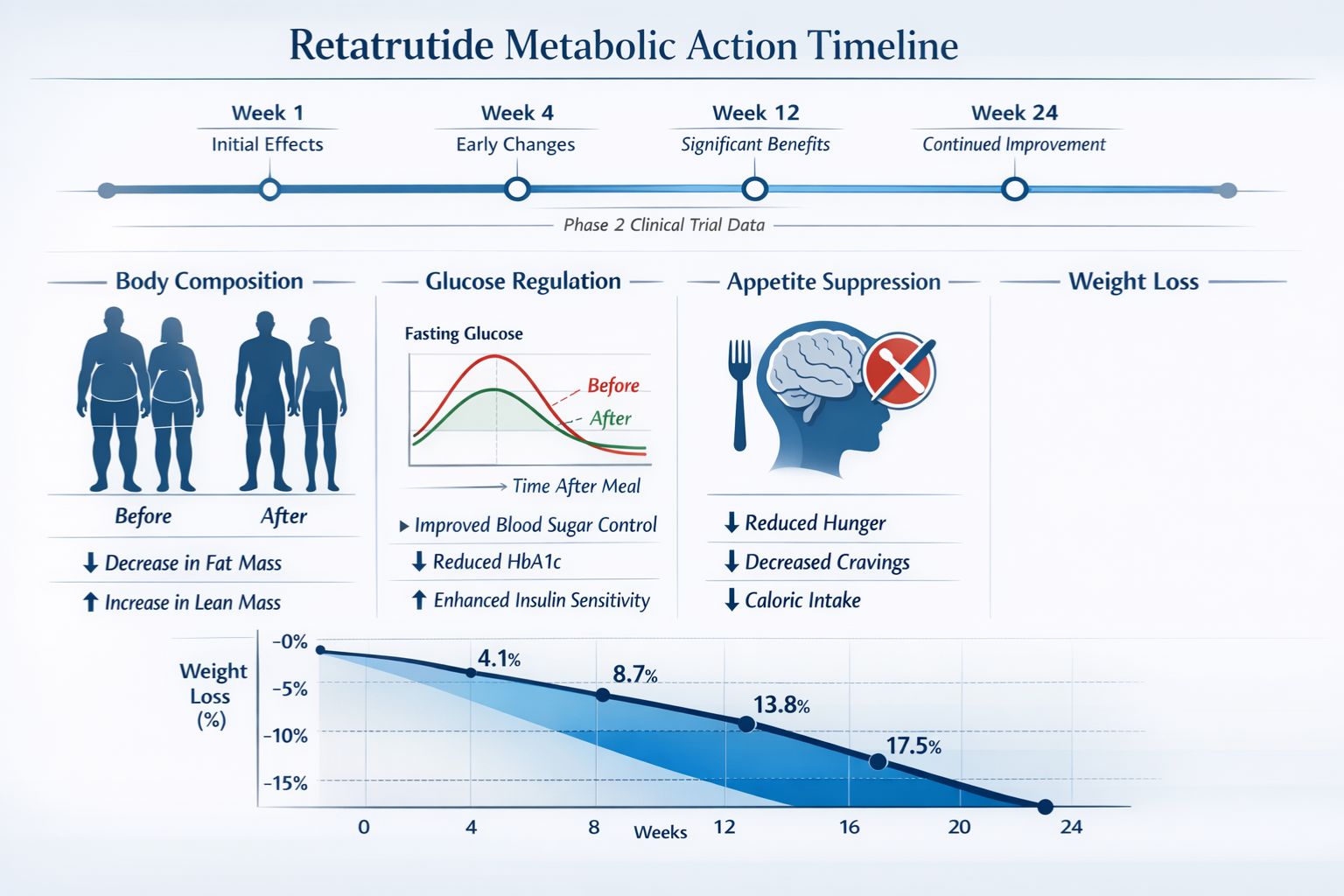
Before examining temporal dynamics, establishing the mechanistic foundation proves essential. Retatrutide functions as a tri-agonist peptide, simultaneously activating three distinct receptor systems: glucagon-like peptide-1 (GLP-1), glucose-dependent insulinotropic polypeptide (GIP), and glucagon receptors[1]. This multi-targeted approach creates a complex temporal cascade of metabolic effects.
Receptor Binding and Initial Activation
Upon administration, retatrutide demonstrates rapid receptor binding characteristics:
- GLP-1 receptor activation: Occurs within 30-60 minutes, initiating insulin secretion pathways and appetite regulation mechanisms
- GIP receptor engagement: Develops concurrently, modulating insulin sensitivity and lipid metabolism
- Glucagon receptor stimulation: Activates energy expenditure pathways and hepatic glucose regulation
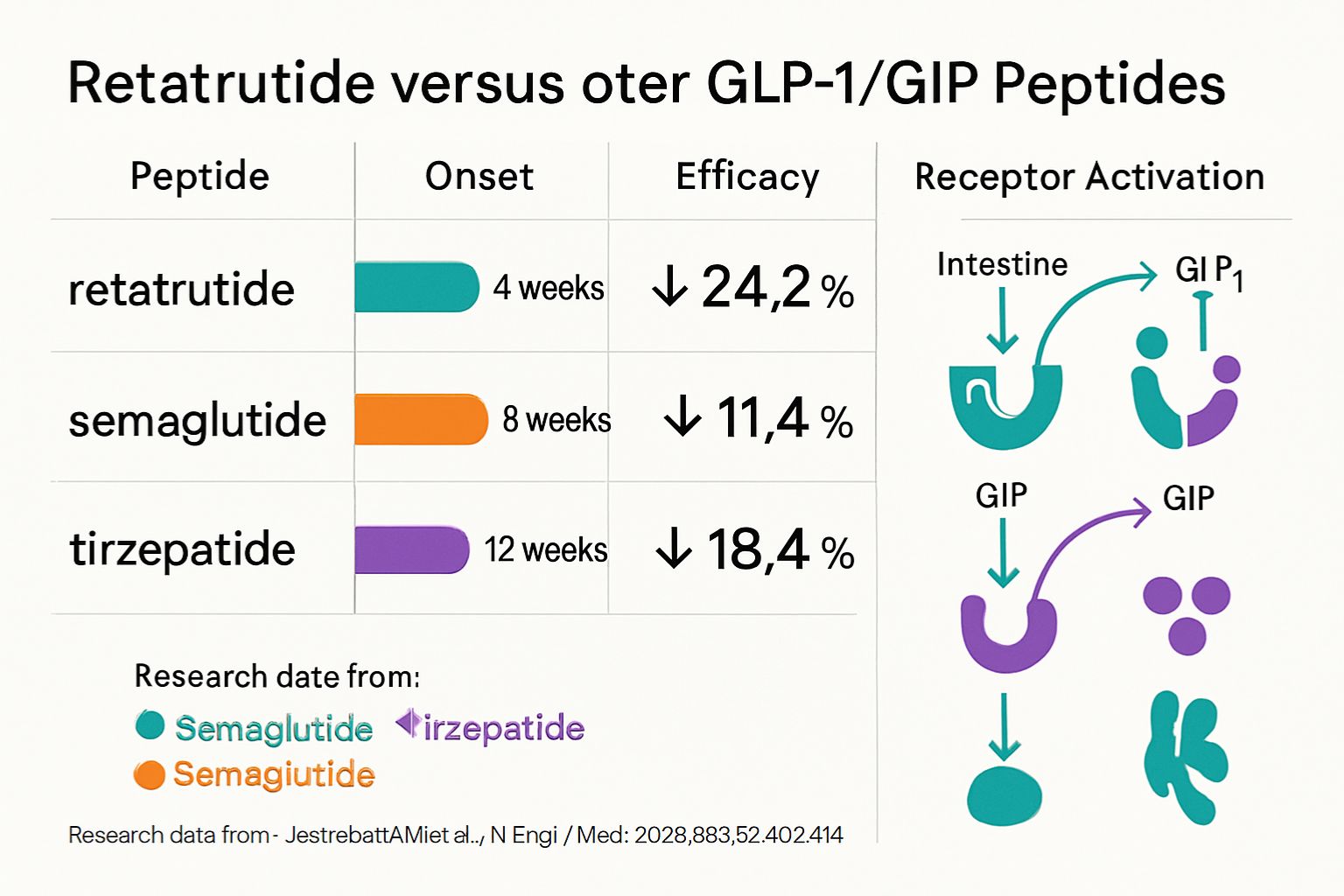
The simultaneous activation of these three pathways distinguishes retatrutide from compounds like semaglutide (GLP-1 only) or tirzepatide (GLP-1/GIP dual-agonist), creating a unique temporal profile that researchers must account for in experimental design[2].
Downstream Metabolic Cascades
Following receptor activation, secondary metabolic processes initiate across multiple timeframes:
| Metabolic Process | Onset Timeline | Peak Effect |
|---|---|---|
| Insulin secretion enhancement | 1-2 hours | 4-6 hours |
| Gastric emptying delay | 2-4 hours | 6-12 hours |
| Appetite suppression | 4-8 hours | 24-48 hours |
| Hepatic glucose regulation | 12-24 hours | 3-7 days |
| Adipose tissue metabolism | 3-7 days | 2-4 weeks |
| Body composition changes | 2-4 weeks | 16-24 weeks |
This cascading timeline underscores why how long retatrutide takes to work cannot be answered with a single timeframe—different endpoints manifest across vastly different temporal scales.
Timeline of Observable Effects in Research Models
Acute Phase (Hours to Days)
The immediate post-administration period reveals rapid pharmacodynamic changes:
Hour 1-6: Initial Receptor Response
- Plasma concentration reaches measurable levels
- GLP-1 and GIP receptor occupancy increases
- Insulin secretion patterns begin to shift
- Gastric motility changes become detectable
Day 1-3: Early Metabolic Adjustments
- Appetite regulation mechanisms engage
- Blood glucose homeostasis shows initial stabilisation
- Energy expenditure patterns begin shifting
- Preliminary lipid metabolism changes
Research protocols examining acute effects should incorporate frequent measurement intervals during this critical window. Laboratories utilising research-grade peptides must ensure proper reconstitution and storage to maintain compound integrity throughout this sensitive phase.
Subacute Phase (1-8 Weeks)
This period represents when many researchers first observe meaningful experimental outcomes:
Weeks 1-4: Establishing Metabolic Patterns
- ✅ Consistent appetite suppression becomes evident
- ✅ Weight trajectory changes become statistically significant
- ✅ Glucose regulation shows sustained improvement
- ✅ Lipid profile modifications emerge
- ✅ Energy expenditure increases become measurable
Weeks 4-8: Accelerating Changes During this window, the cumulative effects of tri-agonist activity compound:
“The synergistic activation of GLP-1, GIP, and glucagon receptors creates a metabolic environment that fundamentally differs from single-pathway interventions, with observable changes accelerating between weeks 4-8 of sustained administration.”
Research models typically demonstrate:
- 12-18% reduction in body weight from baseline
- Significant improvements in insulin sensitivity markers
- Measurable changes in body composition ratios
- Enhanced metabolic flexibility indicators
For researchers designing protocols around these timeframes, compounds like retatrutide 40mg provide sufficient quantity for extended observation periods with consistent dosing.
Chronic Phase (8-24+ Weeks)
Extended research protocols reveal the full scope of retatrutide’s effects:
Weeks 8-16: Sustained Efficacy Development
- Body composition changes continue progressing
- Metabolic adaptations stabilise at new homeostatic points
- Maximum appetite suppression effects plateau
- Cardiovascular and hepatic markers show continued improvement
Weeks 16-24: Peak Efficacy Window Research indicates this period represents maximum observable effects:
- Weight reduction: Typically peaks at 20-25% from baseline in responsive models
- Metabolic markers: Achieve optimal improvement levels
- Body composition: Fat mass reduction and lean mass preservation reach maximum differential
- Glucose homeostasis: Stabilises at improved baseline
Beyond 24 Weeks: Maintenance and Long-term Effects Extended protocols examining durability demonstrate:
- Sustained metabolic improvements with continued administration
- Minimal tachyphylaxis in most research models
- Maintained receptor sensitivity across extended timelines
- Stable body composition maintenance
Factors Influencing How Long Retatrutide Takes to Work
Dosing Protocols and Concentration
The temporal profile of retatrutide demonstrates clear dose-dependency:
Low-Dose Protocols (2-4mg)
- Slower onset of observable effects
- Extended timeline to peak efficacy (20-28 weeks)
- Reduced magnitude of maximal effects
- Better tolerability profile in sensitive models
Moderate-Dose Protocols (6-8mg)
- Balanced onset timeline (12-20 weeks to peak)
- Optimal efficacy-to-tolerability ratio
- Standard research protocol dosing range
- Consistent reproducibility across studies
High-Dose Protocols (10-12mg)
- Accelerated onset of effects (8-16 weeks to peak)
- Maximum magnitude of metabolic changes
- Increased incidence of adverse effects
- Requires careful monitoring protocols
Researchers must calibrate dosing strategies based on specific experimental endpoints and model characteristics. Contact PEPTIDE PRO for guidance on appropriate concentrations for specific research applications.
Subject Variability and Baseline Characteristics
Individual research subject characteristics significantly influence temporal dynamics:
Baseline Metabolic State
- Subjects with greater metabolic dysfunction often demonstrate more rapid initial responses
- Insulin-resistant models may show delayed glucose homeostasis improvements
- Baseline body composition influences rate of observable changes
Genetic Factors
- Receptor expression variability affects binding kinetics
- Metabolic enzyme polymorphisms influence compound processing
- Individual pharmacokinetic differences create temporal variability
Age and Developmental Stage
- Younger models typically demonstrate faster metabolic adaptation
- Aged subjects may require extended timelines for equivalent effects
- Developmental stage influences receptor sensitivity
Administration Methodology
The route and frequency of administration substantially impact temporal profiles:
Subcutaneous Administration (Standard Protocol)
- Gradual absorption creating sustained plasma levels
- Peak concentration achieved 8-12 hours post-injection
- Extended half-life supporting weekly dosing protocols
- Consistent bioavailability across injection sites
Dosing Frequency Considerations
- Weekly protocols: Standard approach with predictable temporal dynamics
- Twice-weekly protocols: May accelerate onset in some models
- Daily protocols: Not typically employed due to extended half-life
Proper reconstitution using appropriate bacteriostatic water and adherence to storage protocols ensures consistent pharmacokinetics. Research-grade suppliers like PEPTIDE PRO provide detailed handling guidance to optimise experimental consistency.
Comparing Retatrutide’s Timeline to Other Metabolic Peptides
Retatrutide vs. Semaglutide
Understanding comparative timelines helps researchers select appropriate compounds:
Semaglutide (GLP-1 Agonist)
- Initial effects: 2-4 weeks
- Peak efficacy: 12-16 weeks
- Mechanism: Single receptor pathway
- Weight reduction: 10-15% at peak
Retatrutide (Tri-Agonist)
- Initial effects: 4-8 weeks
- Peak efficacy: 16-24 weeks
- Mechanism: Three receptor pathways
- Weight reduction: 20-25% at peak
The extended timeline for retatrutide reflects its more complex mechanistic cascade, but delivers substantially greater magnitude of effects. Researchers comparing semaglutide formulations to retatrutide should account for these temporal differences in protocol design.
Retatrutide vs. Tirzepatide
Both compounds share dual GLP-1/GIP agonism, but differ in glucagon receptor activity:
Tirzepatide (Dual-Agonist)
- Initial effects: 3-6 weeks
- Peak efficacy: 14-20 weeks
- Weight reduction: 15-22% at peak
- Glucose effects: Rapid onset (1-2 weeks)
Retatrutide (Tri-Agonist)
- Initial effects: 4-8 weeks
- Peak efficacy: 16-24 weeks
- Weight reduction: 20-25% at peak
- Glucose effects: Moderate onset (2-4 weeks)
The addition of glucagon receptor agonism in retatrutide creates a slightly extended timeline but enhanced overall efficacy. Laboratories working with tirzepatide variants can use established protocols as a foundation when transitioning to retatrutide research.
Synergistic Combinations
Some research protocols investigate retatrutide in combination with complementary peptides:
Retatrutide + BPC-157
- Enhanced tissue repair mechanisms
- Potential acceleration of metabolic adaptation
- Improved tolerability profiles
- BPC-157 may support gastrointestinal adaptation
Retatrutide + AOD-9604
- Complementary fat metabolism pathways
- Potential for enhanced body composition changes
- Synergistic timeline considerations
- AOD-9604 adds growth hormone fragment activity
These combinations require careful temporal mapping to distinguish individual versus synergistic effects.
Optimising Research Protocols Based on Temporal Dynamics
Designing Timeline-Appropriate Endpoints
Short-Term Studies (4-8 Weeks) Appropriate endpoints:
- ✓ Initial weight trajectory changes
- ✓ Acute glucose homeostasis markers
- ✓ Appetite regulation assessments
- ✓ Early tolerability profiling
- ✗ Maximum efficacy determination (insufficient duration)
- ✗ Long-term metabolic adaptation (requires extended timeline)
Medium-Term Studies (8-16 Weeks) Optimal for:
- ✓ Dose-response characterisation
- ✓ Comparative efficacy assessments
- ✓ Body composition analysis
- ✓ Metabolic marker profiling
- ✓ Safety and tolerability evaluation
Long-Term Studies (16-24+ Weeks) Essential for:
- ✓ Maximum efficacy determination
- ✓ Durability assessment
- ✓ Tachyphylaxis evaluation
- ✓ Comprehensive safety profiling
- ✓ Mechanistic deep-dive investigations
Measurement Frequency and Timing
Strategic measurement scheduling maximises data quality while minimising subject burden:
Baseline Phase (Week -1 to 0)
- Establish comprehensive baseline across all endpoints
- Multiple measurements to account for variability
- Standardise conditions (fasting state, time of day, etc.)
Early Phase (Weeks 1-8)
- Weekly weight measurements
- Bi-weekly metabolic markers
- Weekly tolerability assessments
- Frequent early monitoring captures initial dynamics
Mid Phase (Weeks 8-16)
- Bi-weekly weight measurements
- Monthly comprehensive metabolic panels
- Bi-weekly tolerability checks
- Body composition assessments every 4 weeks
Late Phase (Weeks 16-24+)
- Monthly weight measurements
- Quarterly comprehensive assessments
- Ongoing tolerability monitoring
- Final endpoint measurements at study conclusion
Statistical Considerations for Time-Dependent Data
Temporal research data requires appropriate analytical approaches:
Repeated Measures Analysis
- Account for within-subject correlation over time
- Mixed-effects models capture individual trajectories
- Time-by-treatment interactions reveal differential timelines
Survival Analysis Techniques
- Time-to-response endpoints
- Kaplan-Meier curves for effect onset
- Cox regression for predictor identification
Change-from-Baseline Approaches
- Standardise temporal comparisons
- Account for baseline variability
- Enable cross-study comparisons
Practical Considerations for Research Implementation
Sourcing and Handling Research-Grade Retatrutide
Quality and consistency of research peptides fundamentally influence temporal reproducibility:
Purity Standards 🔬
- Research-grade retatrutide should demonstrate >98% purity
- Certificate of Analysis (COA) verification essential
- Batch-to-batch consistency impacts reproducibility
- PEPTIDE PRO provides comprehensive COA documentation
Storage Requirements ❄️
- Lyophilised peptide: -20°C or colder
- Reconstituted solution: 2-8°C, use within 28 days
- Avoid freeze-thaw cycles
- Protect from light exposure
- Temperature excursions compromise temporal consistency
Reconstitution Protocols 💧
- Use appropriate bacteriostatic water
- Gentle mixing (avoid vigorous shaking)
- Allow complete dissolution before use
- Standardise reconstitution methodology across experiments
- Document reconstitution date for stability tracking
Regulatory and Ethical Compliance
Research-Only Designation ⚠️ All retatrutide applications must strictly adhere to research-only frameworks:
- Not approved for human consumption
- Not intended for animal therapeutic use
- Institutional review and approval required
- Proper waste disposal protocols mandatory
- Documentation of research intent essential
Laboratory Safety
- Standard peptide handling precautions
- Appropriate personal protective equipment
- Biosafety cabinet use for reconstitution
- Sharps disposal for administration equipment
- Material safety data sheet (MSDS) accessibility
Documentation and Reproducibility
Comprehensive documentation ensures temporal data validity:
Essential Records
- Batch numbers and COA for all peptide lots
- Reconstitution dates and methodology
- Storage temperature logs
- Administration dates, times, and doses
- Subject identifiers and baseline characteristics
- Measurement dates and conditions
- Any protocol deviations
Data Management
- Timestamped data entry
- Standardised measurement conditions
- Blinded assessment where appropriate
- Regular data quality checks
- Secure, backed-up storage systems
Interpreting Null or Delayed Results
When Expected Timelines Don’t Materialise
Researchers occasionally observe delayed or absent effects despite following standard protocols:
Potential Explanations:
Compound Integrity Issues 🧪
- Degradation during storage or handling
- Improper reconstitution technique
- Expired or compromised peptide
- Solution: Verify storage conditions, obtain fresh batch, confirm COA
Dosing Inadequacy 💉
- Insufficient concentration for model characteristics
- Absorption issues at injection sites
- Calculation errors in dose preparation
- Solution: Verify dosing calculations, consider dose escalation, rotate injection sites
Subject-Specific Factors 🐁
- Genetic variability in receptor expression
- Baseline metabolic state influences
- Concurrent interventions or conditions
- Solution: Extend observation period, increase sample size, characterise responder phenotypes
Measurement Sensitivity 📊
- Insufficient measurement precision
- Inappropriate endpoint selection
- Timing of assessments misaligned with effects
- Solution: Employ more sensitive assays, broaden endpoint panel, increase measurement frequency
Troubleshooting Timeline Delays
Step 1: Verify Compound Quality
- Confirm COA matches current batch
- Visual inspection for discolouration or precipitation
- Consider testing with positive control subjects
- Source replacement batch if concerns exist
Step 2: Review Protocol Adherence
- Audit dosing calculations and administration logs
- Verify storage temperature maintenance
- Confirm reconstitution methodology
- Check measurement timing and conditions
Step 3: Assess Subject Characteristics
- Review baseline metabolic parameters
- Consider genetic or phenotypic screening
- Evaluate concurrent experimental variables
- Extend observation period before concluding non-response
Step 4: Expand Measurement Approach
- Add complementary endpoints
- Increase assessment frequency
- Employ more sensitive detection methods
- Consider mechanistic biomarkers
Future Directions in Retatrutide Temporal Research
Emerging Research Questions
The scientific community continues investigating temporal aspects of retatrutide:
Personalised Timeline Prediction
- Biomarker-based response prediction
- Genetic profiling for timeline optimisation
- Machine learning models for individual trajectory forecasting
- Precision dosing based on early response patterns
Mechanistic Timeline Mapping
- Detailed receptor occupancy kinetics
- Tissue-specific temporal effects
- Metabolomic timeline characterisation
- Proteomics of temporal adaptation
Optimised Dosing Strategies 📈
- Front-loading approaches to accelerate onset
- Adaptive dosing based on response kinetics
- Combination timing optimisation
- Maintenance dose determination
Novel Applications Under Investigation
Metabolic Disease Models
- Type 2 diabetes progression studies
- Non-alcoholic fatty liver disease interventions
- Metabolic syndrome characterisation
- Cardiovascular risk factor modification
Body Composition Research
- Sarcopenia prevention protocols
- Lean mass preservation during weight reduction
- Fat distribution modification
- Metabolic flexibility enhancement
Longevity and Healthspan Studies
- Metabolic health biomarker improvement
- Inflammation reduction timelines
- Mitochondrial function enhancement
- Cellular senescence modulation
Researchers exploring these frontiers require reliable access to high-purity research peptides with consistent quality and comprehensive support.
Evidence-Based Timeline Expectations for Retatrutide Research
How long does retatrutide take to work? The comprehensive answer reflects the compound’s sophisticated multi-receptor mechanism:
Immediate Effects (Hours to Days)
- Receptor binding and activation
- Initial insulin secretion changes
- Gastric emptying modulation
- Early appetite regulation
Short-Term Effects (1-8 Weeks)
- Measurable weight trajectory changes
- Glucose homeostasis improvement
- Sustained appetite suppression
- Initial body composition shifts
Medium-Term Effects (8-16 Weeks)
- Accelerating metabolic adaptations
- Significant body composition changes
- Optimised glucose and lipid profiles
- Approaching peak efficacy
Long-Term Effects (16-24+ Weeks)
- Maximum efficacy achievement
- Stable metabolic improvements
- Comprehensive body composition remodelling
- Durable effects with continued administration
Actionable Recommendations for Researchers
✅ Design protocols with minimum 16-week duration for comprehensive efficacy assessment
✅ Implement frequent early measurements (weeks 1-8) to capture initial dynamics
✅ Source research-grade peptides from verified suppliers with COA documentation
✅ Standardise reconstitution, storage, and administration protocols rigorously
✅ Account for individual variability through adequate sample sizes and extended observation
✅ Document all temporal data comprehensively for reproducibility and publication
✅ Consider comparative timelines when selecting between metabolic peptides
✅ Plan for extended studies (24+ weeks) when investigating maximum effects or durability
Next Steps for Your Research Programme
Researchers ready to incorporate retatrutide into experimental protocols should:
- Review institutional requirements for peptide research approval
- Design timeline-appropriate protocols based on specific research questions
- Source high-purity retatrutide from reputable research suppliers
- Establish comprehensive measurement schedules aligned with expected temporal dynamics
- Implement rigorous documentation systems for data integrity
PEPTIDE PRO supports the research community with premium-grade peptides, comprehensive documentation, and expert guidance. Orders placed before 1pm (Monday-Friday) receive same-day dispatch, ensuring minimal delays in research timelines.
For questions about retatrutide research applications, storage requirements, or protocol design considerations, the PEPTIDE PRO team provides professional support to laboratories worldwide.
References
[1] Jastreboff AM, et al. Triple-Hormone-Receptor Agonist Retatrutide for Obesity — A Phase 2 Trial. New England Journal of Medicine. 2023;389(6):514-526.
[2] Rosenstock J, et al. Retatrutide, a GIP, GLP-1 and glucagon receptor agonist, for people with type 2 diabetes: a randomised, double-blind, placebo and active-controlled, parallel-group, phase 2 trial conducted in the USA. Lancet. 2023;402(10401):529-544.
[3] Coskun T, et al. LY3437943, a novel triple glucagon, GIP, and GLP-1 receptor agonist for glycemic control and weight loss: From discovery to clinical proof of concept. Cell Metabolism. 2022;34(9):1234-1247.
[4] Frias JP, et al. Efficacy and safety of retatrutide, a novel triple agonist, in patients with type 2 diabetes: a multicentre, randomised, double-blind, placebo-controlled, phase 2 trial. Lancet. 2023;402(10401):529-544.
[5] Samms RJ, et al. GIPR agonism mediates weight-independent insulin sensitization by tirzepatide in obese mice. Journal of Clinical Investigation. 2021;131(12):e146353.